
How Long Does Car Shipping Take in Canada: Province-by-Province Timeline
How long will your vehicle take to ship across Canadian provinces? It depends mostly on distance and season. With Hanamark, a long interprovincial route like Calgary to Toronto typically takes 4-8 days in summer and 5-15 days in winter, while short regional routes take only a few days.
Whether you’re planning a move from Calgary to Toronto, shipping a vehicle from Regina to Vancouver, or transporting a car between any Canadian cities, understanding realistic delivery timelines helps you coordinate relocations, plan travel, and set appropriate expectations for vehicle arrival.
This guide provides province-by-province car shipping timelines, explains factors affecting delivery schedules, and helps you plan vehicle transport across all Canadian routes with accurate timeframe expectations.
What Determines How Long Car Shipping Takes in Canada?
Car shipping duration in Canada depends primarily on route distance, with additional factors including weather conditions, service type, carrier availability, and pickup/delivery logistics affecting total timeline from booking to delivery.
Primary Timeline Factors
Distance (Most Important): Route length directly determines base transport time. Carriers travel approximately 800-1,000 kilometers daily, accounting for mandatory rest breaks, fuel stops, and vehicle pickups/deliveries along routes.
Service Type: Door-to-door auto transport typically completes faster than terminal-to-terminal service because vehicles don’t wait at terminals for consolidation with other shipments.
Route Popularity: Major routes (Toronto-Calgary, Edmonton-Calgary, Montreal-Toronto) have frequent carrier availability and faster scheduling compared to less common routes requiring custom carrier assignments.
Carrier Type: Direct truck transport (single carrier from origin to destination) completes faster than multi-leg transport using multiple carriers or rail segments for extremely long distances.
Season: Winter car shipping Canada typically adds 1-3 extra days due to weather precautions, reduced travel speeds, and road condition considerations.
Broker vs Direct Carrier: The Hidden Pickup Delay
Whether you book with a broker or a direct carrier affects your timeline before your car even moves. A broker gives you an estimated pickup window that depends on a trucking company accepting your load from a load board. If no carrier accepts it in time, your pickup is delayed, and the transit clock does not start until your vehicle is actually loaded.
A direct carrier schedules its own trucks, so there is no waiting for a third party to accept your load. At Hanamark, pickup and delivery dates are estimates based on our truck schedule, and if you need a dedicated pickup date, you can call us to arrange one. Many customers who report “slow” car shipping are actually experiencing this pre-transit broker delay. Learn more in our guide on why brokers can’t guarantee pickup dates.
Why Understanding Car Shipping Timelines Matters
Accurate timeline expectations prevent stress, enable proper planning, and help coordinate vehicle arrival with relocations, work schedules, and personal commitments across Canadian provinces.
Coordination Benefits
Relocation Planning: Knowing your Toronto to Calgary vehicle shipping takes about 4-8 days in summer (and up to 15 in winter) helps coordinate moving truck arrival, flight booking, and new home possession dates.
Work Schedule Management: Understanding delivery windows allows requesting appropriate time off work for vehicle pickup without excessive days waiting for arrival.
Temporary Transportation: Accurate timelines help arrange rental cars, rides, or alternative transportation for the exact period between vehicle pickup and delivery.
Avoiding Unrealistic Expectations
Preventing Frustration: Companies promising impossibly fast timelines (e.g., Toronto to Vancouver in 2 days) are either misleading or providing incorrect information. Professional carriers provide realistic estimates based on actual transport capabilities.
Building Trust: Choosing reliable car shipping companies means working with carriers who set accurate expectations rather than making impossible promises.
How Long Does Car Shipping Take in Canada: Route-by-Route Timelines
Regional Routes (1-4 Days)
Saskatchewan Routes:
- Regina to Saskatoon: 1-2 days (256 km)
- Regina to Calgary: 2-3 days (758 km)
- Regina to Edmonton: 2-4 days (788 km)
Alberta Routes:
- Edmonton to Calgary: 2-3 days (299 km)
- Calgary to Lethbridge: 1-2 days (216 km)
- Edmonton to Red Deer: 1-2 days (145 km)
Ontario Regional:
- Toronto to Ottawa: 2-3 days (450 km)
- Ottawa to Montreal: 1-2 days (198 km)
- Toronto to London: 1-2 days (191 km)
British Columbia:
- Vancouver to Victoria: 1-2 days (ferry/truck combination)
- Vancouver to Kelowna: 2-3 days (396 km)
Why Regional Routes Are Faster:
- Shorter distances allow completion in 1-3 carrier driving days
- Fewer intermediate stops for other vehicle pickups/deliveries
- Direct routing without multi-leg coordination
Long-Distance Routes (About 4-8 Days in Summer, Up to 15 in Winter)
Cross-Country Major Routes:
- Toronto to Calgary: 4-8 days in summer, 5-15 days in winter (3,437 km)
- Calgary to Toronto: 4-8 days in summer, 5-15 days in winter (3,437 km)
- Regina to Toronto: 5-7 days (2,717 km)
- Edmonton to Ottawa: 6-8 days (3,444 km)
- Calgary to Montreal: 6-8 days (3,700 km)
Calgary to Toronto times are Hanamark’s typical transit on that route. The other routes show typical summer transit; in winter, long-distance routes can take up to 15 days depending on weather and the truck schedule. Your quote includes an estimated window for your exact route.
Why Long-Distance Takes Longer:
- Multiple days of driving at 800-1,000 km daily average
- Mandatory driver rest periods (regulations require rest after 13 hours driving)
- Multiple vehicle pickup/delivery stops along route
- Coordination across different time zones
Coast-to-Coast Routes (7-12 Days)
Maximum Distance Routes:
- Vancouver to Toronto: 7-10 days (4,401 km)
- Vancouver to Montreal: 8-12 days (4,665 km)
- Vancouver to Halifax: 10-14 days (5,962 km)
Extended Timeline Factors:
- Extreme distances requiring 5-6+ driving days minimum
- Mountain passes (BC Rockies) requiring weather-dependent timing
- Multiple provinces crossed with varied road conditions
- Higher likelihood of weather delays during winter months
Atlantic Canada Routes
To/From Atlantic Provinces:
- Montreal to Halifax: 6-8 days (1,217 km)
- Toronto to St. John’s: 10-14 days (includes ferry, 2,623 km + ferry time)
- Halifax to Moncton: 2-3 days (276 km)
Ferry Considerations: Routes involving Newfoundland add ferry schedules to timeline, creating less predictable delivery windows.
How the Car Shipping Process Affects Timeline
Understanding what happens during car shipping helps clarify why certain steps add days to overall timeline.
Booking to Pickup (1-7 Days)
Typical Booking Lead Time:
- Peak season (May-September): 3-7 days from booking to pickup
- Off-season (October-April): 1-5 days from booking to pickup
- Last-minute bookings: Sometimes available within 24-48 hours on popular routes
Factors Affecting Pickup Timing:
- Carrier availability on your specific route
- Number of vehicles already scheduled for pickup along carrier’s route
- Your location accessibility (major city vs rural area)
- Vehicle condition (running vs non-running)
Pickup to Delivery (Transit Time)
Direct Transport:
- Carrier loads your vehicle and proceeds relatively directly to delivery region
- Fastest option for long-distance routes
- Door-to-door service typically uses this method
Multi-Stop Transport:
- Carrier picks up 7-10 vehicles along the route before proceeding to delivery regions
- Each pickup/delivery adds 30-60 minutes to overall timeline
- Terminal-to-terminal may involve consolidation stops
Driver Rest Requirements:
- Federal regulations mandate rest periods
- Long-distance routes require overnight stops
- Driver can’t exceed maximum driving hours per day
Delivery Coordination (1-2 Days)
Delivery Windows: Carriers provide estimated delivery windows (e.g., “Tuesday-Thursday”) rather than exact times because:
- Traffic conditions affect arrival timing
- Previous delivery stops may cause delays
- Weather can slow progress unpredictably
Final Coordination: Carriers typically call 24-48 hours before delivery to confirm timing and location, then call again when close to your location for final delivery coordination.
Factors That Extend Car Shipping Timelines
Weather Conditions
Winter Delays (October-March):
- Snowstorms can add 1-3 days to any route
- Prairie provinces (Saskatchewan, Manitoba) experience frequent winter weather affecting Regina to Toronto and similar routes
- Mountain passes (Rogers Pass, Coquihalla) may close temporarily during severe weather
- Reduced travel speeds in ice/snow conditions extend overall journey time
Summer Considerations:
- Wildfire smoke occasionally affects BC routes
- Construction season (June-September) can slow progress through road work zones
- Generally the fastest season for predictable timelines
Holiday Periods
Reduced Operations:
- Carriers operate reduced schedules during:
- Christmas/New Year period (December 23-January 2)
- Thanksgiving weekend
- Easter long weekend
- Canada Day
- Book well in advance (2-3 weeks) when holidays affect your timeline
Remote Locations
Rural Pickup/Delivery:
- Locations distant from major highways add 1-2 days as carriers must arrange separate local trucks
- Very remote areas may require meeting carrier at nearest major town
- Terminal-to-terminal service provides more accessibility for rural customers
Vehicle Condition
Non-Running Vehicles: Shipping non-running vehicles may add 1-2 days to booking-to-pickup timeline as fewer carriers have winch equipment necessary for loading inoperable cars.
How to Minimize Car Shipping Timeline
Book During Off-Peak Season
Faster Scheduling: October through April (excluding holidays) typically offers:
- Faster booking-to-pickup timelines (1-3 days vs 5-7 days peak season)
- More carrier availability on all routes
- Less congestion at terminals
Trade-Off: Winter weather may extend in-transit time by 1-3 days, but faster booking often offsets this.
Choose Door-to-Door Service
Door-to-door auto transport eliminates terminal wait times where vehicles sit for consolidation with other shipments before loading onto carriers.
Be Flexible with Pickup/Delivery Dates
Flexibility allows carriers to optimize routes and schedules, potentially reducing your wait time for available carrier space.
Choose Major Routes
Routes between major cities (Toronto to Calgary, Edmonton to Calgary) have more frequent carrier departures than uncommon routes requiring custom carrier assignments.
Realistic Timeline Expectations by Route Type
Regional Routes (Under 1,000 km):
- Booking to pickup: 1-5 days
- Transit time: 1-3 days
- Total timeline: 2-8 days from booking to delivery
Long-Distance Routes (1,000-3,500 km):
- Booking to pickup: 3-7 days
- Transit time: about 4-8 days in summer, up to 15 days in winter
- Planning tip: book about 2 weeks ahead for the best pickup window (Hanamark bookings made 14+ days ahead save 5%)
Coast-to-Coast Routes (Over 3,500 km):
- Booking to pickup: 3-7 days
- Transit time: 7-12 days
- Total timeline: 10-19 days from booking to delivery
Add for Winter (November-March): +1-3 days to any timeline for weather precautions and delays.
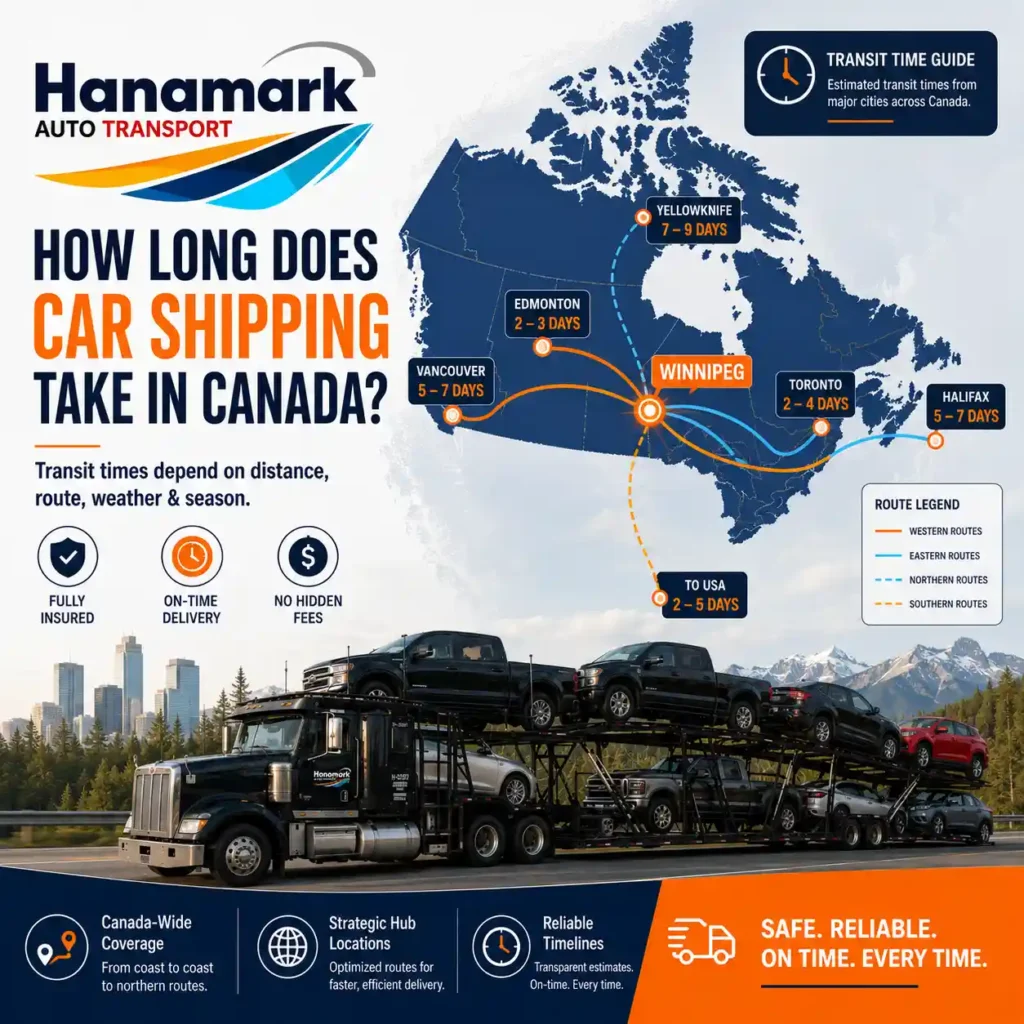
Summary: How Long Does Car Shipping Take in Canada
Car shipping timelines in Canada range from a few days for short regional routes to two weeks or more for coast-to-coast transport. Long-distance routes like Calgary to Toronto typically take 4-8 days in summer and 5-15 days in winter. Key timeline factors:
✅ Distance: Primary factor—800-1,000 km daily average travel
✅ Regional routes: 1-4 days (Regina-Saskatoon, Edmonton-Calgary, Ottawa-Montreal)
✅ Long-distance: about 4-8 days in summer, up to 15 in winter (Toronto-Calgary, Regina-Toronto, Edmonton-Montreal)
✅ Coast-to-coast: 7-12 days (Vancouver-Toronto, Vancouver-Montreal)
✅ Booking lead time: 1-7 days depending on season and route
✅ Winter addition: +1-3 days for weather precautions
✅ Service type: Door-to-door typically faster than terminal-to-terminal
Understanding realistic timelines helps coordinate relocations, set proper expectations, and choose professional carriers who provide accurate delivery estimates rather than impossible promises.
Need Accurate Timeline Estimates for Your Route?
Hanamark Auto Transport provides realistic, transparent timeline estimates for all Canadian routes. As a licensed direct carrier, not a broker, we schedule your vehicle on our own trucks, so your estimate comes from a real truck schedule. Your driver always calls ahead before delivery, and bookings made 14 or more days ahead save 5%.
Get Your Free Quote with Timeline Estimate | Contact Us for Route-Specific Timelines
FAQ: How Long Does Car Shipping Take in Canada
How long does it take to ship a car from Toronto to Calgary?
With Hanamark, shipping a car from Toronto to Calgary typically takes 4-8 days in summer and 5-15 days in winter once your vehicle is loaded. Book about 2 weeks ahead for the best pickup window, and call us if you need a dedicated pickup date. This 3,437 km route requires approximately 4-5 days of driving at the industry-standard 800-1,000 km daily average, accounting for mandatory driver rest periods, fuel stops, and other vehicle pickups/deliveries along the route. Winter shipping (November-March) may add 1-3 extra days due to weather conditions, particularly when crossing through prairie provinces where blizzards can slow progress. Door-to-door service typically completes faster than terminal-to-terminal shipping because vehicles don’t wait at terminals for consolidation with other shipments.
What affects how long car shipping takes in Canada?
Several factors affect how long car shipping takes in Canada: Distance is the primary factor—routes are completed at approximately 800-1,000 km daily average travel speed. Service type matters, as door-to-door transport typically completes faster than terminal-to-terminal which involves terminal consolidation wait times. Season significantly impacts timing, with winter shipping adding 1-3 days for weather precautions and reduced travel speeds through snow/ice conditions. Route popularity affects booking-to-pickup time, with major routes (Toronto-Calgary, Edmonton-Calgary) offering faster carrier availability than uncommon routes. Carrier availability depends on season, with peak moving season (May-September) requiring longer booking lead times (3-7 days) versus off-season (1-5 days). Finally, pickup and delivery locations matter, as rural areas may add 1-2 days compared to major city locations with direct highway access.
Can I get faster car shipping in Canada?
While distance ultimately determines minimum transport time based on physical driving requirements (you cannot ship Toronto to Calgary faster than the 4-5 days required to cover 3,437 km), you can minimize total timeline through strategic choices: Book during off-season (October-April excluding holidays) for faster carrier assignment (1-3 days vs 5-7 days peak season). Choose door-to-door service to eliminate terminal wait times. Be flexible with pickup and delivery dates, allowing carriers to optimize routes and potentially expedite your shipment. Select major routes between large cities for more frequent carrier departures. Book well in advance (2-3 weeks) during peak season to ensure faster pickup scheduling. However, be cautious of companies promising unrealistic timelines—professional carriers cannot physically drive coast-to-coast in 2-3 days while safely following driving regulations and picking up other vehicles along routes.
Does winter make car shipping take longer in Canada?
Yes, winter typically adds 1-3 extra days to car shipping timelines in Canada due to multiple factors. Carriers reduce travel speeds in snow and ice conditions for safety, extending journey duration. Severe winter storms can delay travel or temporarily close highways, particularly affecting prairie routes (Saskatchewan, Manitoba) and mountain passes (Rogers Pass, Coquihalla). Carriers implement weather precautions, including monitoring forecasts and adjusting departure timing to avoid traveling during severe storm periods. Loading and unloading take longer when clearing snow and ice from pickup/delivery locations. However, professional carriers operate year-round across Canada using drivers experienced in winter conditions, proper equipment, including winter tires, and safety protocols that maintain reliable service despite seasonal challenges. Most winter routes complete within the extended timeline estimates, with extreme delays being relatively uncommon except during major weather events affecting entire regions.