
SUV Shipping Canada: How Does Open Carrier Transport Handle Canada’s Most Popular Vehicle Type?
Did you know that multipurpose vehicles – the category that includes SUVs and crossovers- now account for 62.9% of all new motor vehicle registrations in Canada, making them the dominant vehicle type on Canadian roads for the first time in history, up from 59.7% just one year earlier? According to Statistics Canada’s New Motor Vehicle Registrations Q4 2024 report, multipurpose vehicles also saw the largest year-over-year growth of any vehicle category at 13.9%, meaning more Canadians are shipping SUVs across provinces than ever before (Source: https://www150.statcan.gc.ca/n1/daily-quotidien/250313/dq250313c-eng.htm).
If you own an SUV, crossover, or multipurpose vehicle and need to move it across Canadian provinces, this guide explains how open carrier SUV shipping in Canada works – from how your vehicle is loaded and secured to what affects the timeline and how to prepare your specific vehicle type for professional interprovincial transport.
What Is SUV Shipping Canada? Understanding Open Carrier Transport for Larger Vehicles
SUV shipping in Canada refers to the professional interprovincial transport of sport utility vehicles, crossovers, and multipurpose vehicles using open carrier trucks – the same equipment and process used for any passenger vehicle, adapted for the specific dimensions and characteristics of larger vehicles.
What Counts as an SUV for Canadian Open Carrier Transport?
For shipping purposes, the SUV category covers a wide range of vehicle types:
Compact crossovers such as the Honda CR-V, Toyota RAV4, Mazda CX-5, and Hyundai Tucson. These vehicles are standard-sized for open carrier loading and require no special accommodation.
Mid-size SUVs including the Ford Explorer, Jeep Grand Cherokee, Toyota Highlander, Chevrolet Traverse, and similar vehicles. These are common on Canadian carriers and loaded routinely.
Full-size SUVs such as the Chevrolet Suburban, Ford Expedition, GMC Yukon XL, and Cadillac Escalade. These larger vehicles require careful positioning on the carrier to accommodate their height and length.
Three-row crossovers and large family vehicles of various makes and models. The key factors are overall height, length, and weight – not brand or model specifically.
Lifted SUVs with aftermarket suspension modifications require individual assessment because significant lift kits change ground clearance angles on carrier loading ramps and may affect standard securing points.
How Open Carrier Trucks Accommodate SUVs in Canada
Professional open carrier trucks are designed to transport a range of vehicle sizes simultaneously, including SUVs and larger vehicles. Carriers use hydraulic ramp systems to load vehicles onto upper and lower carrier decks, and drivers are trained in weight distribution and positioning to safely configure mixed loads — sedans alongside SUVs and crossovers — within transport safety regulations.
For most standard and mid-size SUVs, the loading process is straightforward and identical in process to any passenger vehicle — the vehicle is driven up the carrier ramp to its assigned position, secured with tie-down straps at the designated anchor points on the vehicle frame, and verified before departure.
🔗 See how professional loading works: Car Carrier Truck Loading System (https://hanamark.com/car-carrier-truck-loading-system-guide/)
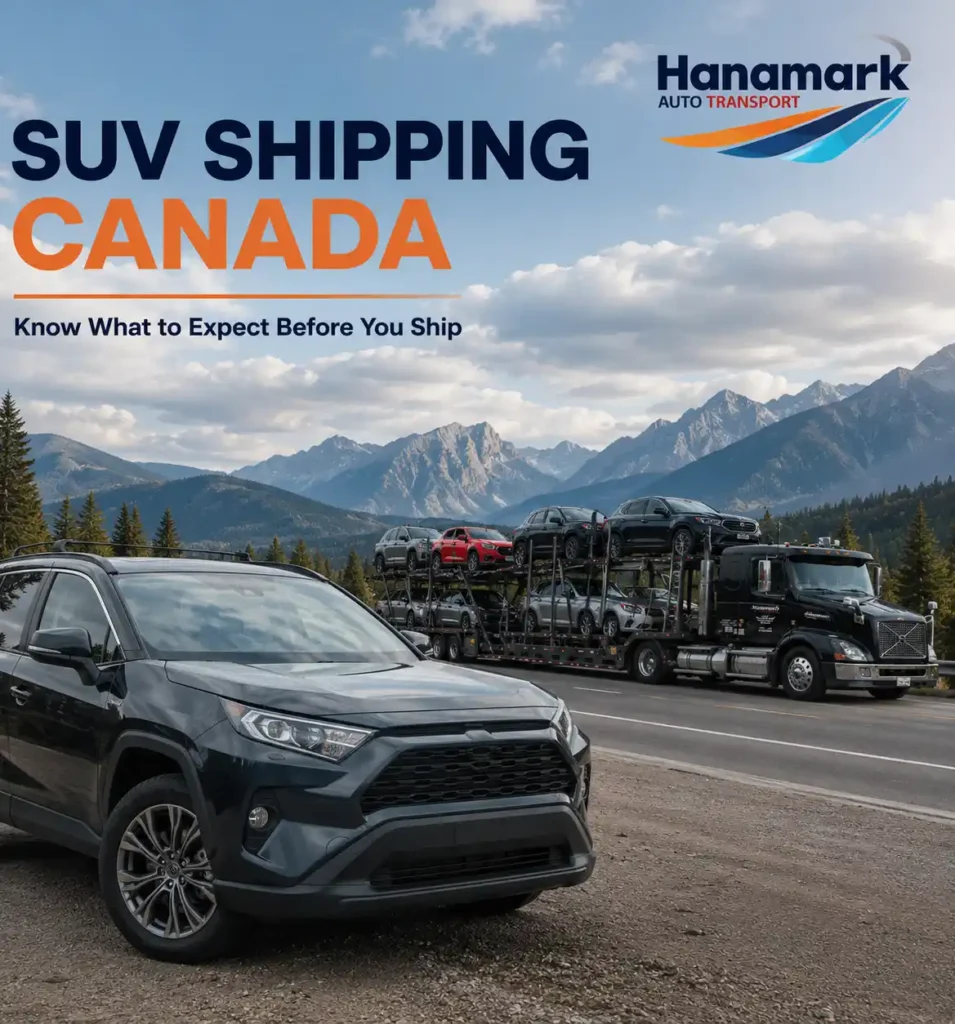
Why SUV Shipping Canada Is the Practical Choice for Interprovincial Moves
SUVs and Crossovers Are Not Built for 3,000+ km Self-Drives Across Canada
The irony of Canada’s most popular vehicle type is that SUVs – designed and marketed for versatility and adventure – are not efficiently suited for multi-day, multi-province self-drives when the goal is simply moving the vehicle from one province to another. A 3,400 kilometre drive from Calgary to Toronto, for example, adds wear to the vehicle that owners of smaller sedans also face but that disproportionately affects larger vehicles through fuel consumption, brake wear, and tire stress.
Professional open carrier shipping eliminates all of this while you simply take a direct flight to your destination and collect your vehicle on arrival.
Fuel Costs on Self-Drive Are Significantly Higher for SUVs
A full-size SUV consuming 12 to 15 litres per 100 kilometres at Canadian fuel prices adds up quickly on a cross-country route. A Toronto to Calgary self-drive of 3,400 kilometres at 13L/100km and $1.65/L average Canadian pump price costs approximately $729 in fuel alone – before accommodation, meals, vehicle wear, or the return transportation back to Ontario if it is a one-way move.
Professional SUV shipping removes that direct fuel cost from the customer’s responsibility and delivers the vehicle without the driver exhaustion of a multi-day highway marathon.
Corporate Relocations with SUVs: Employer Vehicle Policies and Professional Transport
Many Canadian corporate relocation packages include professional vehicle transport as standard — particularly for employees moving family SUVs across provinces. The professional open carrier model aligns with corporate vehicle relocation policies that require licensed carriers with cargo insurance documentation. Employees shipping family SUVs during corporate relocations should confirm with their employer that open carrier transport is the approved method before booking.
🔗 Related: Vehicle Transport for Corporate Relocation Canada (https://hanamark.com/vehicle-transport-corporate-relocation-canada/)
Dealerships Moving SUV Inventory Across Canada
SUVs and crossovers represent a major portion of dealership inventory movements across Canadian provinces. Dealer trades, auction purchases, and inventory balancing all require professional carrier transport. With multipurpose vehicles representing 62.9% of new registrations in Canada, open carrier SUV shipping is a core component of any dealership’s inventory logistics program.
🔗 Related: Car Transport for Dealerships (https://hanamark.com/car-transport-for-dealerships/)
How SUV Shipping Canada Works: The Complete Open Carrier Process
Step 1: Provide Accurate Vehicle Details When Requesting Your Quote
SUV shipping quotes in Canada require accurate vehicle information because vehicle dimensions affect carrier positioning and load configuration. When requesting a quote for open carrier SUV transport, provide:
Year, make, and model of your SUV. Ground clearance – particularly if your vehicle has aftermarket lift modifications. Whether the vehicle is a standard height or raised suspension configuration. Whether your SUV is running and self-drivable onto the carrier ramp, or non-operational requiring winch loading. Overall vehicle length if you own an extended-length model such as a Suburban or Expedition Max.
Accurate information at the quote stage ensures no surprises at pickup and allows proper carrier planning.
Step 2: Prepare Your SUV for Open Carrier Pickup
Preparing an SUV for open carrier shipping in Canada follows the same process as any vehicle, with a few SUV-specific considerations:
Remove roof racks, crossbars, and cargo carriers if they are removable. These accessories add height and can interfere with carrier deck clearance, particularly on upper deck positions. Remove bike racks, trailer hitches with accessories, and any external attachments that extend beyond the vehicle’s standard profile. Retract antenna if it is manually adjustable. Remove personal belongings – cargo insurance covers the vehicle, not contents. Deflate rooftop cargo boxes if fitted and non-removable, or arrange for their removal before transport.
🔗 Full preparation checklist: Prepare Your Car for Shipping Canada (https://hanamark.com/preparing-car-cross-canada-shipping-checklist/)
Step 3: The Condition Inspection – More Important for SUVs
For SUVs – which often have more surface area, body panels, running boards, and exterior features than sedans – the Bill of Lading condition inspection at pickup is particularly important. A thorough inspection documents all sides of the vehicle, including:
All four body panels, roof panel, hood, and tailgate. Running boards and rocker panel lower sections. Wheel arches and lower body cladding. Exterior mirrors, lights, and any factory exterior accessories.
Take your own photographs from all angles before the driver arrives, and review the Bill of Lading carefully with the driver to confirm accuracy. The more thorough the pickup documentation, the clearer any delivery comparison will be.
🔗 Related: Car Shipping Bill of Lading Canada (https://hanamark.com/car-shipping-bill-of-lading-canada/)
Step 4: Transit and Delivery of Your SUV Across Canada
Open carrier SUV shipping timelines across Canadian provinces depend on the specific route:
Short interprovincial routes (Regina to Calgary, Edmonton to Calgary): 1 to 2 days. Mid-distance routes (Winnipeg to Toronto, Calgary to Vancouver): 3 to 7 days. Long-distance cross-country routes (Toronto to Vancouver, Edmonton to Halifax): 7 to 14 days.
Your SUV is secured on the carrier throughout transit using industry-standard tie-down straps attached to the vehicle’s chassis anchor points – the same engineered securing points used in manufacturer transport from factory to dealer.
At delivery, the condition inspection compares your SUV’s state against the pickup Bill of Lading. Any concerns are noted before you sign the delivery confirmation.
🔗 Related: How Long Does Car Shipping Take Canada (https://hanamark.com/how-long-car-shipping-take-canada/)
SUV Shipping Canada: Common Vehicles and Specific Considerations
Standard and Compact Crossovers (CR-V, RAV4, CX-5, Tucson, Escape)
These vehicles are entirely standard on open carriers and present no loading or transit challenges. They are the most frequently shipped vehicle type in Canada and are accommodated on both upper and lower carrier deck positions without issue.
Mid-Size SUVs (Explorer, Highlander, Grand Cherokee, Traverse, Pilot)
Mid-size SUVs are routinely transported on Canadian open carriers. Their height and length fall within standard carrier dimensions, and experienced drivers position them efficiently within mixed loads. No special requirements for standard factory configuration vehicles.
Full-Size SUVs (Suburban, Expedition, Yukon XL, Escalade, Armada)
Full-size SUVs require attention to carrier deck height clearance – particularly on upper deck positions- and drivers confirm clearance during loading. These vehicles are transported regularly across Canadian provinces and are well within professional carrier capability, but their dimensions mean they are typically positioned on lower carrier decks.
Lifted SUVs and Modified Vehicles
Aftermarket lift kits significantly affect the loading ramp angle required to get the vehicle onto the carrier, and raised suspension changes the relationship between frame height and standard tie-down anchor points. If your SUV has aftermarket lift modifications, communicate the lift height clearly at the quote stage so the carrier can confirm their equipment accommodates your specific configuration. Standard lifts of two to four inches are typically manageable; larger custom lifts require individual carrier assessment.
Why Choose Hanamark for SUV Shipping in Canada
Hanamark is a licensed direct open carrier with experience transporting all types of SUVs and crossovers across Canadian provinces:
We own our open carrier trucks and employ our drivers – no third-party handoffs. Our drivers are trained for all vehicle types, including full-size SUVs, crossovers, and modified vehicles. Cargo insurance covers your SUV throughout the entire interprovincial journey. A thorough Bill of Lading inspection at pickup and delivery protects your vehicle documentation. Door-to-door service means we come to your location and deliver to your destination.
🔗 Related: Long Distance Auto Transport Canada (https://hanamark.com/moving-across-canada-with-car-guide/)
Summary: SUV Shipping Canada on Open Carriers Across Provinces
SUV shipping in Canada follows the same professional open carrier process as any interprovincial vehicle transport, adapted for the specific dimensions and characteristics of the SUV and crossover vehicles that now make up 62.9% of all new Canadian vehicle registrations. Compact and mid-size crossovers ship without special requirements on standard open carriers. Full-size SUVs are accommodated with appropriate carrier deck positioning. Lifted or modified vehicles require advance communication of lift height for carrier confirmation. The preparation process – removing roof racks, cargo carriers, and personal belongings – is straightforward and ensures smooth pickup. Hanamark provides direct carrier SUV shipping across all major Canadian interprovincial routes with cargo insurance active throughout, thorough condition documentation at both pickup and delivery, and experienced drivers trained for all vehicle types and Canadian route conditions year-round.
Key takeaways:
- SUVs and crossovers are Canada’s most popular vehicle type at 62.9% of new registrations, professional carriers handle them routinely
- Remove roof racks, cargo carriers, and external accessories before open carrier pickup
- Full-size SUVs (Suburban, Expedition, Yukon XL) typically load on lower carrier decks due to height
- Lifted SUVs with aftermarket suspension need lift height communicated at quote stage for carrier confirmation
- Bill of Lading inspection at pickup is especially important for SUVs given their larger surface area and accessories
Ready to Ship Your SUV Across Canada? Get Your Open Carrier Quote Today
Hanamark transports SUVs and crossovers on open carriers across all Canadian provinces — compact crossovers, mid-size family SUVs, full-size vehicles, and everything in between. Direct carrier, professional drivers, cargo insurance throughout.
Get Your SUV Shipping Quote Now (https://hanamark.com/quote/)
Call: 306-737-3390 | 📧 Email: info@hanamark.com
FREQUENTLY ASKED QUESTIONS: SUV SHIPPING CANADA
The vast majority of SUVs and crossovers on Canadian roads can be transported on professional open carrier trucks without special requirements. Compact and mid-size crossovers – vehicles like the Honda CR-V, Toyota RAV4, Mazda CX-5, Ford Escape, Chevrolet Equinox, Jeep Grand Cherokee, Ford Explorer, Toyota Highlander – are entirely standard for open carrier loading and represent the most common vehicle type on Canadian interprovincial carriers today. Full-size SUVs including the Chevrolet Suburban, Ford Expedition, GMC Yukon, Cadillac Escalade, and Nissan Armada can also be transported on open carriers, but their height and length typically require lower carrier deck positioning to maintain adequate clearance between deck levels. Experienced carriers work with full-size SUVs regularly and know how to configure loads appropriately. The vehicles that require individual assessment before transport are those with significant aftermarket modifications – particularly large suspension lift kits that raise the vehicle considerably above factory height. A two- to four-inch lift is typically manageable for standard carrier equipment. Larger custom lifts of six inches or more change the loading ramp angle and tie-down anchor relationships enough that carriers need to confirm their specific equipment can accommodate the vehicle before accepting the booking. Communicate any lift modifications clearly at the quote stage. Extended body modifications, bull bars, or large aftermarket accessories that alter the vehicle’s external profile should also be mentioned so the carrier can assess positioning appropriately. Width and length are generally less of a limiting factor on Canadian open carriers than height – the primary constraint for large SUVs is deck-to-deck vertical clearance.
Preparing an SUV for open carrier shipping in Canada involves a few steps specific to the vehicle type beyond standard preparation. First, remove all removable roof accessories – crossbars, cargo carriers, bike racks mounted to roof rails, and rooftop cargo boxes if detachable. These items add height and can interfere with carrier deck clearance. If your rooftop accessory cannot be removed, inform the carrier at booking so they can account for the additional height in positioning. Second, remove all trailer hitch receivers, ball mounts, and any accessories extending behind the vehicle. Standard fixed hitch receivers that are flush with the bumper are typically fine, but extended towbars, bike racks mounted to hitches, or step accessories hanging below the bumper should be removed. Third, remove running board accessories that are aftermarket and removable – factory side steps and running boards are accounted for in the vehicle’s standard profile, but large aftermarket tube steps or drop steps that significantly change the vehicle’s lower clearance may require discussion. Fourth, remove all personal belongings – carrier cargo insurance covers the vehicle, not contents, regardless of vehicle type. Fifth, photograph your SUV thoroughly from all angles, including roof, rocker panels, wheel arches, lower cladding, and all four corners, before the driver arrives. The SUV’s larger surface area means there is more to document, and thorough pre-transport photography gives you complete reference if any questions arise at delivery. Ensure your fuel is at an appropriate level – typically one-quarter tank- and disable aftermarket alarms. If your SUV has an automated parking brake or electronic features that must be in a specific state for towing or moving, note these for the driver at pickup.
Yes, open carrier transport means your vehicle is transported on an uncovered carrier, exposed to weather conditions during interprovincial transit across Canada. This is the standard method used for the overwhelming majority of vehicle shipments in Canada, including how vehicle manufacturers transport new cars from factories to dealerships. The concern about weather exposure is understandable but less significant in practice than it might appear. Rain, snow, and road spray during transit affect the exterior of the vehicle the same way a long highway drive in weather would – the vehicle may arrive dirty, but cosmetic dirt from transit is not vehicle damage. The carrier’s cargo insurance covers physical damage to the vehicle resulting from transport incidents, not cosmetic dirt from normal weather exposure during transit. For the vast majority of SUV owners, standard open carrier is entirely appropriate, and the vehicle is washed after delivery as part of post-transport care. If your SUV is a collector item, a rare vehicle, or has a specialty paint finish that you want protected from any weather exposure, enclosed transport provides a covered trailer environment. Hanamark operates open carrier transport – for customers seeking enclosed transport for specialty SUVs, this would be a different service type to consider. For standard, everyday SUVs and crossovers being relocated between Canadian provinces, open carrier is the professional norm and delivers vehicles safely with no weather-related damage in the overwhelming majority of shipments.
Your SUV is secured on the open carrier using industry-standard tie-down straps attached to designated anchor points on the vehicle’s frame or chassis – the same engineered securing locations used when manufacturers transport new vehicles from production facilities to dealerships across Canada. The tie-down system is designed to prevent any vehicle movement during transit, including acceleration, braking, and road vibration. Each vehicle on the carrier is secured at a minimum of four anchor points, with professional drivers trained to identify the correct anchoring locations for different vehicle types. For SUVs, tie-down points are typically located on the lower frame or chassis rails, not on suspension components, body panels, or wheel spokes – this protects the vehicle’s body and mechanical components from securing damage. The securing hardware uses ratchet straps with soft loop attachments at vehicle contact points to prevent marking or damage to frame surfaces. Drivers verify all vehicle securing before departure and are responsible for monitoring load integrity throughout the transit journey. The wheel chock system used in combination with tie-down straps prevents any forward or backward movement in addition to the lateral and vertical restraint provided by the straps. For modified SUVs with altered suspension geometry or non-factory frame access, the driver will identify appropriate alternative anchor points during loading. If you have concerns about specific anchor points on your SUV based on aftermarket modifications, raise these at pickup so the driver can confirm the securing approach before departure.